Polyester fiber denier is one of the most important specifications to check before you buy staple fiber. It helps you understand the thickness of each fiber strand, but denier alone does not tell you which grade fits your product.
To choose the right fiber, review denier together with cut length, crimp, surface finish and the final application. Alyaf Nemoune offers polyester staple fiber from 4D to 20D with custom cut lengths. For specific production needs, you can review Custom Grade Polyester Staple Fiber.
What Is Denier and How Is It Measured?
Denier measures fiber weight over a fixed length. It helps manufacturers describe whether a fiber strand is finer or thicker.
If 9,000 meters of one fiber strand weighs 4 grams, the fiber is 4 denier. If the same length weighs 20 grams, the fiber is 20 denier.
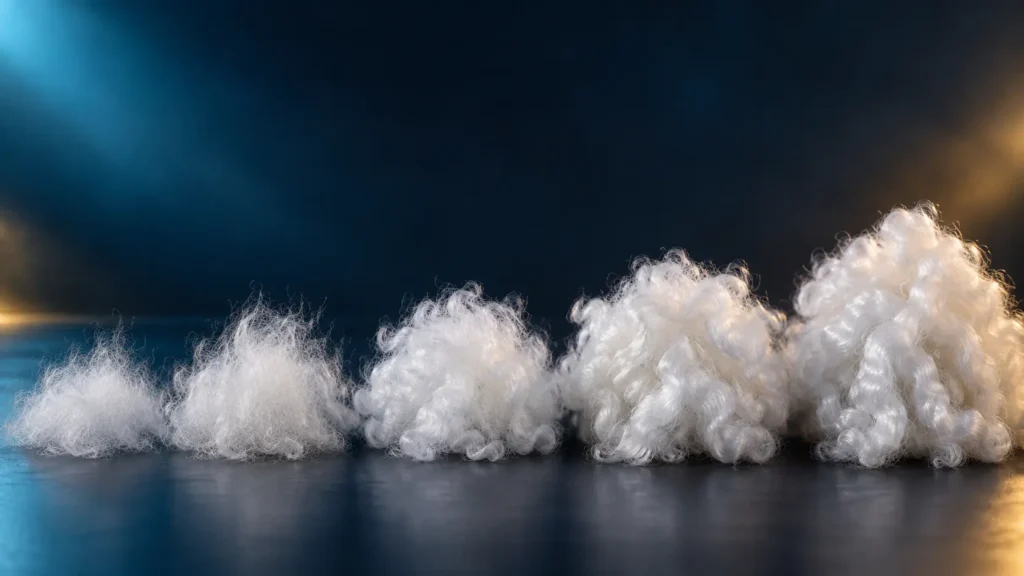
A higher denier usually means a thicker fiber strand. A lower denier usually means a finer fiber strand. However, denier does not define fiber quality on its own.
How Denier Affects Softness, Bulk and Performance
Lower denier fiber usually creates a finer feel. It can suit products that need a softer appearance or a lighter structure.
Higher denier fiber usually creates a thicker structure. It can suit products that need more body or an industrial grade fiber structure.
Denier is only one part of the result. Crimp, raw material, cut length, surface finish and production settings can also affect softness, bulk and fiber behavior.
For example, two fiber grades can have the same denier but perform differently on a production line because they have different crimp levels or surface finishes.
Choosing Denier for the Final Product
Start with the final product. Define how you will use the fiber and what result you expect from it.
Alyaf Nemoune offers 4D, 6D, 8D, 10D, 15D and 20D fiber grades for different industrial needs. The table below gives you a starting point for a discussion with your supplier. Always confirm the final choice with a sample test.
| Denier | General fiber character | Applications to review | Important point |
|---|---|---|---|
| 4D | Fine | Selected textile and light products | Check the sample when appearance and feel matter |
| 6D | Light | Selected filling layers and lighter products | Cut length and crimp can change the result |
| 8D | Medium | Nonwoven materials and general applications | Match the fiber with your production line |
| 10D | Standard | Selected industrial and nonwoven products | Do not choose based on denier alone |
| 15D | Thick | Industrial felt, heavier filling and structural applications | Test fiber behavior in the final product |
| 20D | Heavy industrial | Selected industrial products with a thicker structure | Share your final product requirements clearly |
You can also review the Alyaf Nemoune product range to see available grades and specifications.
Why Lower Denier Does Not Always Mean Better Quality
Some buyers assume that lower denier always means better fiber. This is not correct. Lower denier only means a finer fiber strand.
For dense industrial felt or a structured insulation product, a very fine fiber may not suit the application. On the other hand, a higher denier fiber may not create the feel or structure needed for a lighter product.
Quality means that the fiber matches your requirements. The right fiber should run well on your production line and help you achieve the target result in the final product.
Common Mistakes When Ordering Polyester Fiber Denier
The first mistake is to order fiber based on one number only. Saying “10D polyester fiber” does not give the supplier enough information. You should also define cut length, crimp, color, surface finish and raw material type.
The second mistake is to compare the price of different specifications. Two fiber grades can both be 10D but have different cut lengths or surface finishes. In that case, a direct price comparison does not help you make the right choice.
The third mistake is to skip a sample test. Each production line can respond differently to fiber. Test the sample on your own equipment before you confirm a larger order.
The fourth mistake is to choose denier before you define the final application. Tell the supplier what you manufacture and what result you need from the fiber.
Send Your Application for a Denier Recommendation
You do not need to guess the correct denier. Visit the Alyaf Nemoune Contact Us page and explain what you produce, what type of production line you use and how much fiber you need.
Our team can review your application and suggest a suitable denier and fiber specification. You can also request product samples and a COA.
Frequently Asked Questions
What is the difference between 4D and 20D polyester fiber?
4D fiber has a finer structure. 20D fiber has a thicker structure. The right choice depends on the final product, production line and technical requirement.
Does higher denier always mean stronger fiber?
No. Higher denier indicates a thicker fiber strand. Raw material, crimp, production process and other specifications also affect fiber performance.
What details should I provide when I request a denier?
Share the final application, preferred denier or current sample, cut length, color, required volume and production line sensitivity.
Can Alyaf Nemoune produce custom denier fiber?
Yes. Custom Grade Polyester Staple Fiber can be adjusted according to the application, production process and agreed technical requirements.