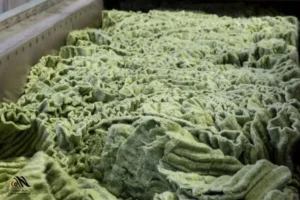
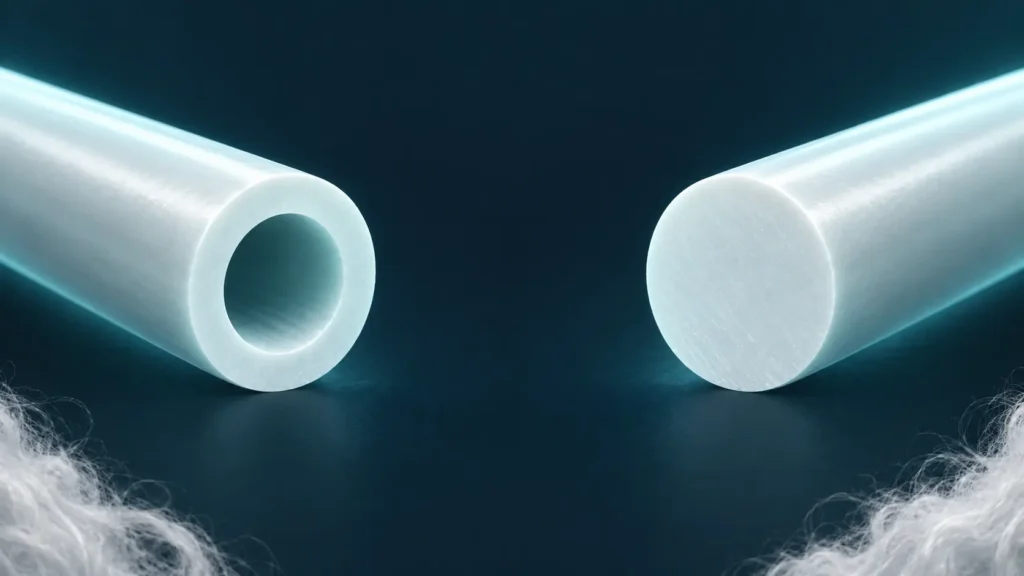
Solid polyester staple fiber consists of short synthetic fibers with a solid cross section and no hollow channel inside. Manufacturers use suitable grades in products such as industrial felt, nonwoven materials, mattress layers and selected insulation products.
To understand where this fiber fits, you need to consider its structure, thickness, cut length and surface finish.
What Is the Difference Between Staple Fiber and Filament?
The terms “staple” and “filament” describe the length and form of the fiber.
A filament is a continuous strand. Manufacturers can process continuous filaments into yarn for textile production. Staple fiber consists of individual short strands that the producer cuts to a specified length and usually supplies in compressed bales.
In some nonwoven processes, equipment opens the short fibers and forms them into a layer. A process such as needle punching then entangles the fibers to give the layer strength and structure.
“Staple” and “solid” therefore describe different features. Staple refers to the short length of the fiber. Solid refers to its internal structure.
How Does Solid Fiber Differ from Hollow Fiber?
Solid fiber has a filled cross section. Hollow fiber has one or more empty channels running along its length.
These channels are different from the spaces between separate fibers. A layer of solid fibers can still hold air between its strands. In hollow fiber, the empty space sits inside each strand.
A hollow structure can help create bulky products with less material for a given outer fiber diameter. However, the cross section alone does not determine softness, recovery after compression or final product quality. Fiber thickness, crimp, finish and the production process also matter.
Solid does not mean virgin. A manufacturer can produce solid fiber from either new or recycled raw material. Fiber structure and raw material type are separate specifications.
The current Alyaf Nemoune product range focuses on solid polyester staple fiber.
What Are the Main Specifications of Solid Polyester Fiber?
The word “solid” explains only one part of the product. Four other specifications help describe how the fiber behaves during processing and in the finished material.
Denier: Fiber Fineness
Denier expresses the mass, in grams, of 9,000 meters of a single fiber. When comparing fibers made from the same material with a similar cross section, a higher denier generally means a thicker strand.
For example, a solid 15 denier polyester fiber is generally thicker than a solid 6 denier polyester fiber.
A higher or lower denier does not automatically mean better quality. The appropriate value depends on the equipment and the properties the finished product needs.
Cut Length: The Length of Each Strand
Cut length describes the length of the individual staple fibers, usually in millimeters.
It affects how the fibers move through equipment and form a layer. Two products with the same denier but different cut lengths may behave differently on the same production line.
This is why manufacturers consider denier and cut length together.
Crimp: The Bends in the Fiber
Crimp describes the small bends or waves along a fiber.
These bends help fibers make contact and engage with one another. They can also affect the bulk and behavior of the fiber layer.
More crimp does not always produce a better result. The amount and shape of the crimp should suit the production process.
Finish: The Surface Treatment
Finish refers to the treatments that manufacturers apply to the fiber surface. These treatments help control properties such as surface friction and processing behavior.
A silicone treatment is one type of finish. It describes the surface of the fiber, while solid and hollow describe its internal structure.
Also, a fiber without a silicone treatment may still have another processing finish. “Non siliconized” does not necessarily mean “no surface treatment.”
Industrial Applications of Solid Polyester Staple Fiber
Alyaf Nemoune identifies several industries as potential users of its products. However, each application requires a suitable grade. A fiber that works well in one product may not suit another.
Nonwoven Materials and Industrial Felt
Nonwoven production does not necessarily use the traditional process of weaving yarn into fabric. Instead, manufacturers form a fiber layer and give it structure through processes such as needle punching.
Solid polyester staple fiber can serve as a raw material for these products.
A uniform layer depends on more than the solid structure. Denier, cut length, crimp and machine settings also influence the result.
Geotextiles and Civil Engineering Materials
Geotextiles are technical textiles for civil engineering applications. Some types use short fibers as their raw material.
The description “solid polyester” alone does not establish suitability for a project. The manufacturer must check whether the finished geotextile meets the required performance, such as mechanical strength or filtration behavior.
The project requirements should guide both fiber selection and testing of the finished material.
Furniture, Mattresses and Filling Products
Manufacturers can use suitable solid fiber grades in selected furniture layers, mattress components and filling products.
The role of the fiber within the product matters. A layer that provides structure may need different specifications from a filling that provides softness and volume.
Before selecting a grade, identify where the fiber will sit and what it needs to do.
Insulation, Filters and Automotive Components
Alyaf Nemoune also lists acoustic and thermal insulation, filters and automotive applications among its target industries.
In these applications, the material blend and product design influence final performance. Using solid polyester fiber alone does not guarantee a particular insulation or filtration result.
The manufacturer needs to evaluate the complete product under the conditions relevant to its intended use.
How Do You Move from Fiber Specifications to Grade Selection?
Start with the role of the fiber in your product. Do you need a uniform layer, structural support or a particular level of softness and volume? Your answer gives the technical discussion a clear starting point.
Next, consider the raw material. Manufacturers produce virgin polyester staple fiber from new raw material and recycled polyester staple fiber from recovered polyester material.
Neither description, on its own, confirms that the fiber will suit your production line. You still need to consider the technical specifications and intended application.
If your process requires a particular combination of denier, cut length, color or raw material, you can discuss custom polyester staple fiber with the manufacturer. The technical team can review your requirements and assess production options.
For the next steps, including sample evaluation, comparing offers and confirming order specifications, read our solid polyester staple fiber buying guide.
Find the Application That Matches Your Product
Choosing a grade starts with understanding the finished product. Fiber specifications become useful when you connect them to a clear production need.
Explore the applications above to identify the role of the fiber before discussing a particular grade.